Thank you for taking action!
This campaign is now closed.
In January 2026, 1029 letters were sent in support of our call for an impact assessment of the ‘Deep Geological Repository’
radioactive waste project
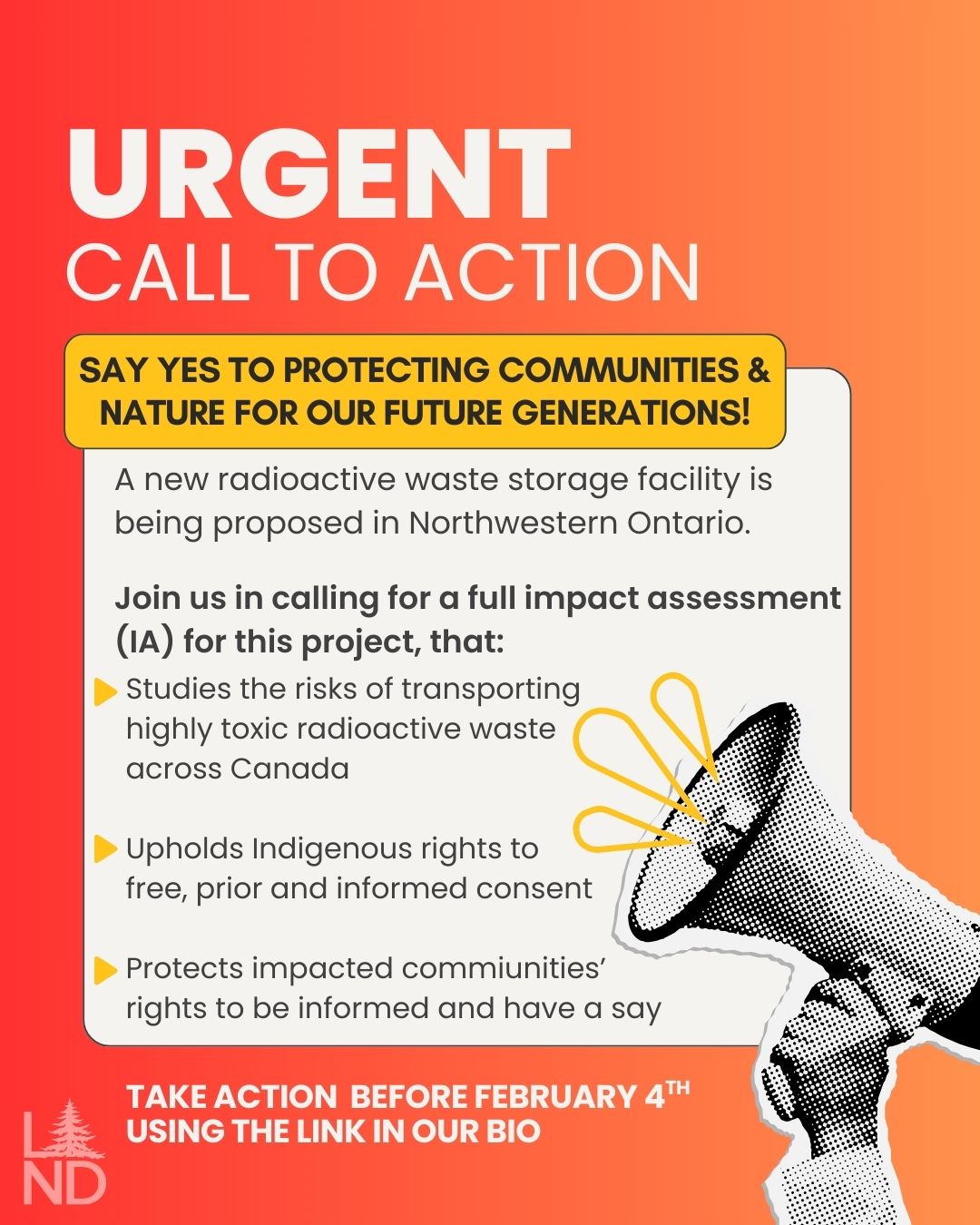
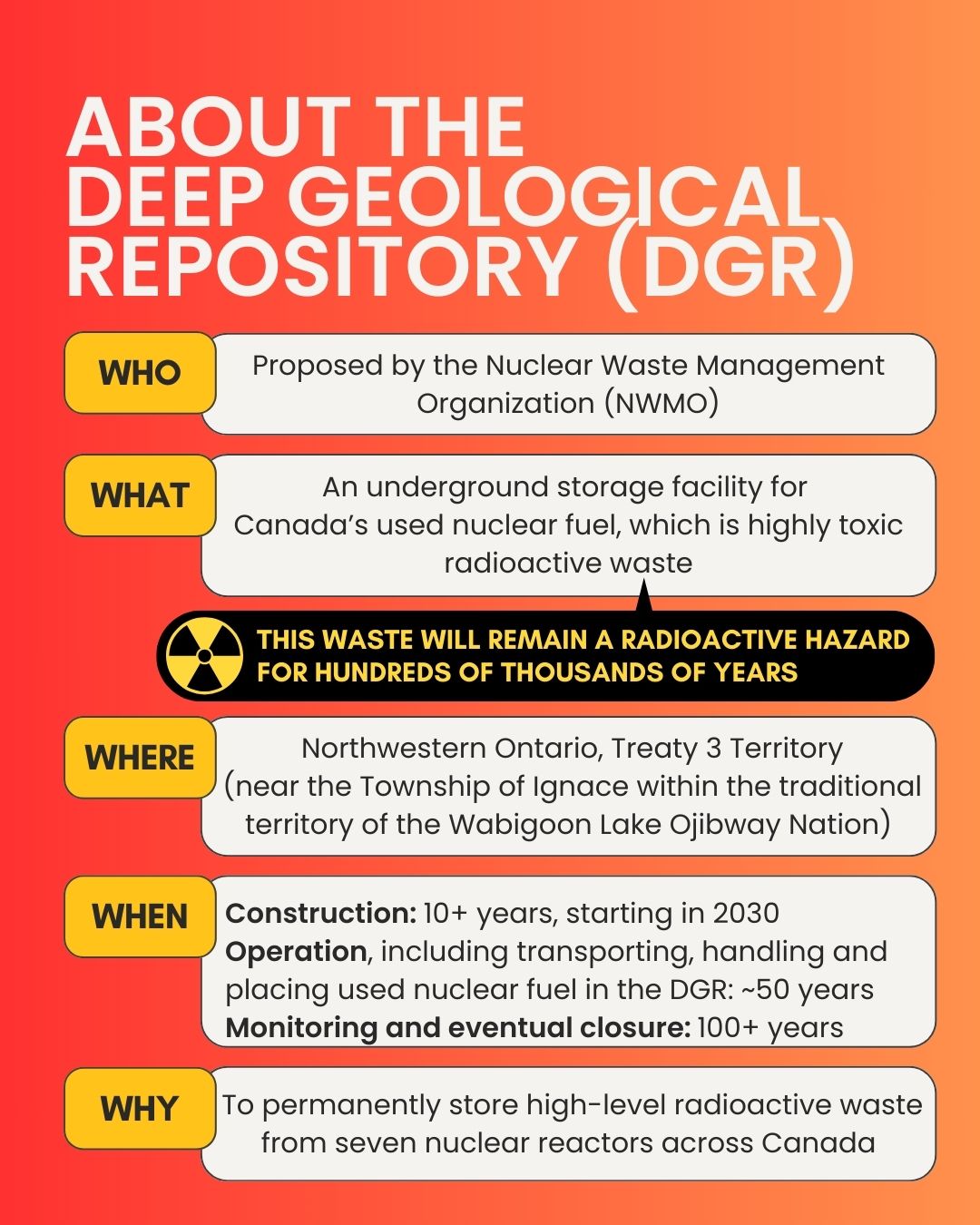
The nuclear industry has unveiled its plans to permanently house Canada’s most long-lived radioactive waste at a proposed deep geological site in Northwestern Ontario. Yet, the project documents ignore transport risks, impacted communities, and Indigenous rights.
Key Things to Know
Background Information
- The project will require the transport of approximately 5.9 million used nuclear fuel bundles over thousands of kilometres to an underground waste repository, with construction beginning as early as 2030.
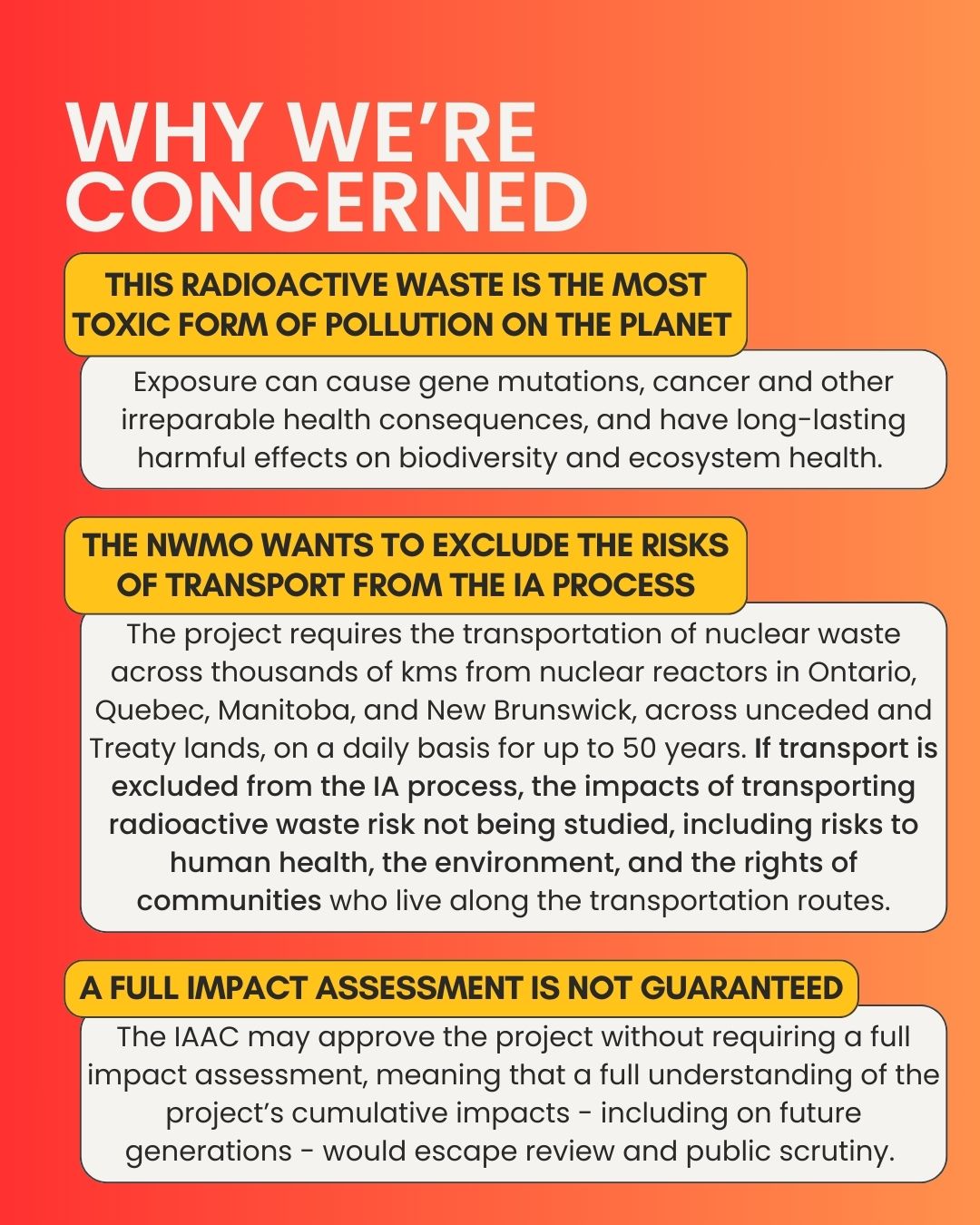
- The project depends on transporting high-level radioactive waste over hundreds of kilometres from nuclear reactors in Ontario, Quebec, Manitoba, and New Brunswick on a daily basis for up to 50 years.
- High-level radioactive waste is highly toxic and dangerous. Accidental exposure can cause gene mutations, cancer and other irreparable health consequences to humans, and have long-lasting harmful effects on biodiversity and ecosystem health.
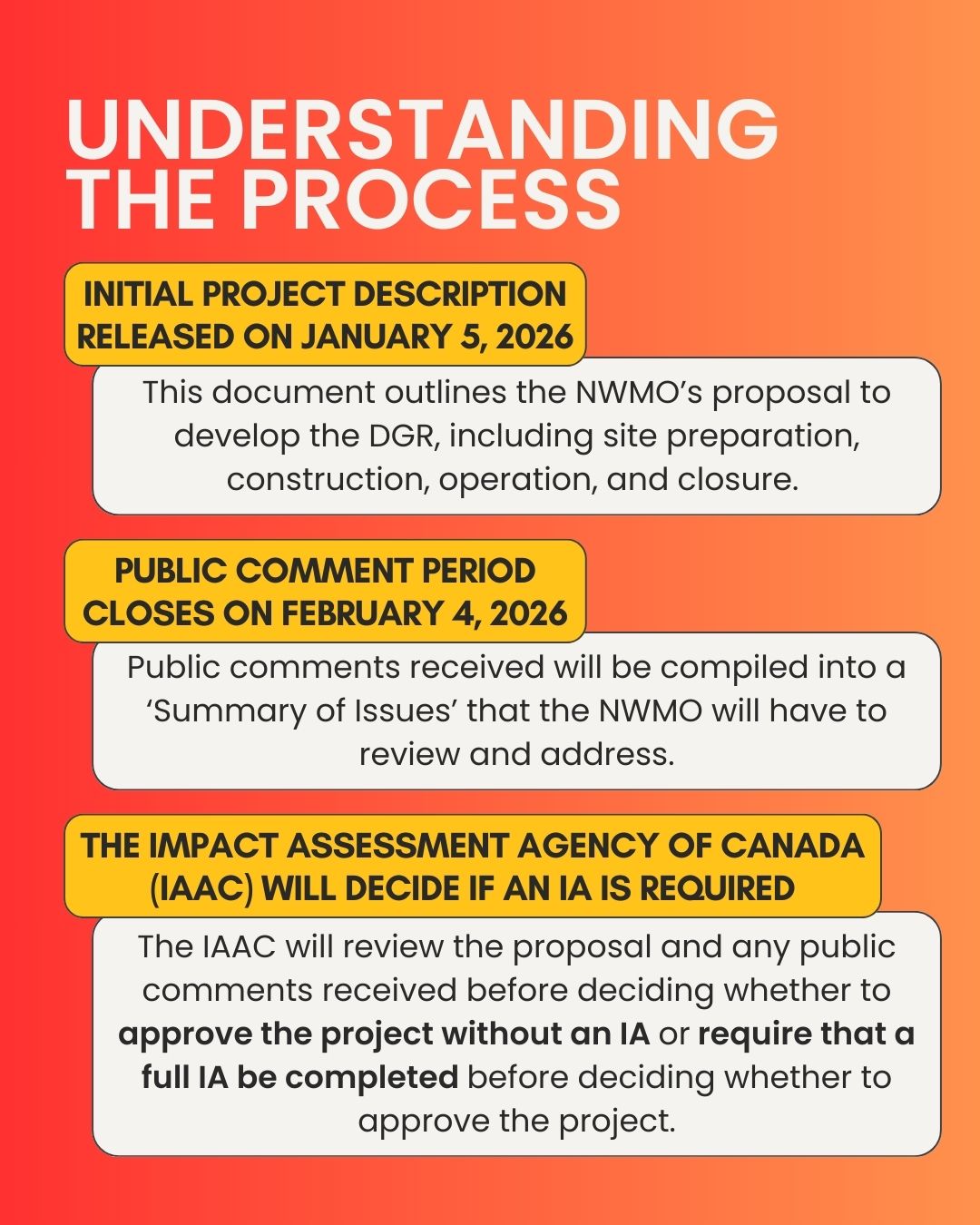
- The Impact Assessment Agency of Canada must decide whether the project should proceed for a federal impact assessment. They are inviting public comments on this decision until February 4, 2026.
Your Voice Matters
Here are some key messages you’re welcome to draw on.
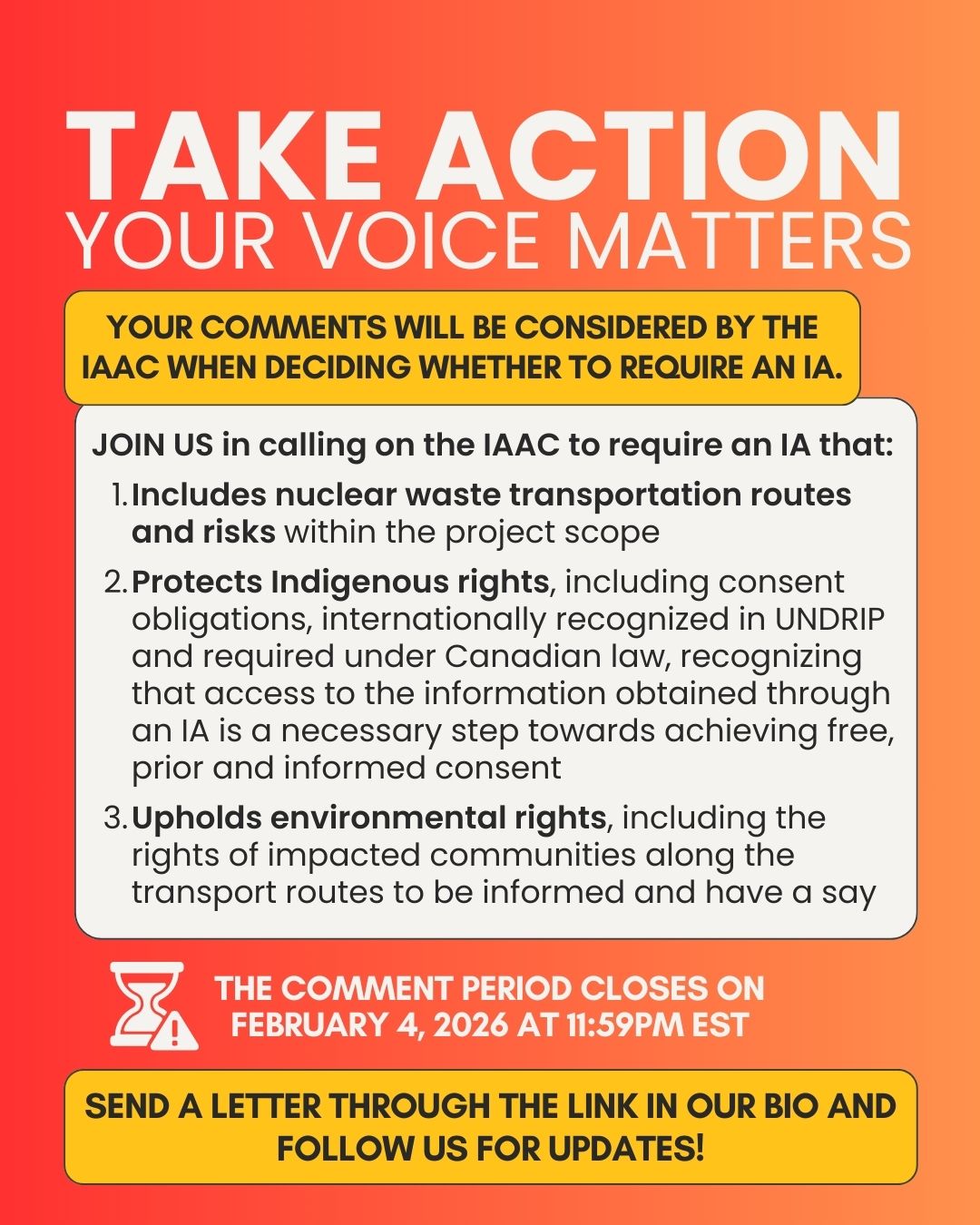
Call for an impact assessment that:
-
Includes nuclear waste transportation routes and risks
within the project's impact assessment so that we can have a full understanding of cumulative effects, impacts on sustainability and future generations
-
Protects Indigenous rights and consent
as recognized by the United Nations Declaration on the Rights of Indigenous Peoples (UNDRIP) and required under Canadian law
-
Upholds environmental justice
including the rights of impacted communities along the route where the high-level waste will be transported on a daily basis for 50 years, to ensure they are informed and have a say
Thank you to the 1,029 citizens that sent letters to the Impact Assessment Agency of Canada and Ministers of Environment and Energy & Natural Resources.
Below is a copy of the letter that was sent.
Dear IAAC, Minister Dabrusin and Minister Hodgson,
I am writing to express my strong support for an impact assessment (IA) of the Deep Geological Repository (DGR) proposed by the Nuclear Waste Management Organization (NWMO).
The project will require the transport of approximately 5.9 million used nuclear fuel bundles over thousands of kilometres to an underground waste site in Northwestern Ontario, with construction beginning as early as 2030. The project depends on transporting high-level radioactive waste from nuclear reactors in Ontario, Quebec, Manitoba, and New Brunswick over a period of up to 50 years.
As currently drafted by the NWMO, the proposed project ignores Indigenous rights and risks to communities along the extensive cross-Canada transport route to the proposed deep geological site in Northwestern Ontario.
This project spans hundreds of communities, from Manitoba to New Brunswick, across unceded and Treaty lands — and it involves the transport and management of the most toxic, long-lived form of pollution known to the planet. That is exactly why it must undergo a full IA and attract the highest level of public scrutiny.
In supporting an IA for this project, the following concerns must be remedied if the project is to proceed in a way that allows for a cumulative review of impacts and prevents, rather than perpetuates, environmental injustice and inter-generational burdens.
1 – Transportation routes and risks must be included within the project’s review
The NWMO’s recently released Initial Project Description indicates that transportation to the project site is excluded from the project scope. This is both illogical and dangerous, as transporting the waste itself is an unavoidable and necessary component of the project and is proposed to be carried out daily for 50 years on major roadways, posing immediate and ongoing risks to communities along the route.
Any attempt to exclude transportation from the IA creates a misleading picture of the project’s true impacts and shields core decisions about transport routes, accident risks, and emergency preparedness from public scrutiny.
This is a project that inherently spans many provinces, Nations and communities and their respective rights. A federal IA is uniquely placed to assess the project’s malfunctions and accidents – including those that are incidental to or directly linked to the project. The transport of nuclear waste must not be allowed to escape review.
2 – Reconciliation requires the inclusion of UNDRIP and that its rights and principles be respected
While the NWMO makes repeated reference to “reconciliation” in their project documents, they adopt an impoverished vision of this obligation – falling short of recognizing Canada’s commitments under the United Nations Declaration on the Rights of Indigenous Peoples (UNDRIP) and the domestic United Nations Declaration on the Rights of Indigenous Peoples Act.
The Impact Assessment Act (IAA) was written with UNDRIP in mind and its implementation is hardwired into its processes and decision-making. For example, the IAA requires consideration of Indigenous rights and Indigenous knowledge, and reaffirms Canada’s commitment to seek the free, prior, and informed consent of Indigenous peoples in relation to decisions under the IAA.
Without a federal IA, there is no clear pathway to ensure Indigenous Peoples’ constitutional and Treaty rights will be respected, and a credible forum provided for impacted rights holders to be consulted and engaged in accordance with their law and protocol.
3 – Environmental justice supports project transparency and accountability
Canada is now facing the consequences of decades of nuclear decision-making that failed to meaningfully examine end-of-life realities, with the fate of some 5.9 million fuel bundles of high-level radioactive waste raising serious concerns of ongoing social and environmental risk.
The IA for the project must apply an environmental justice lens throughout, including an analysis of the effects of the proposed development on Canada’s responsibility to advance environmental justice and to assess, prevent and address environmental per the National Strategy Respecting Environmental Racism and Environmental Justice Act.
Upholding environmental justice means ensuring the fair treatment and meaningful involvement of all people in environmental decision-making — especially when decisions may impact health, safety, and the environment. Furthermore, proceeding with the project absent an IA would perpetuate environmental racism against Indigenous peoples who have historically borne the brunt of environmental harms and continue to be excluded from decision-making processes.
An impact assessment is uniquely positioned to uphold environmental rights by providing a forum where NWMO’s claims of safety, environmental risk and level of impact can be tested and publicly justified.
In closing, I reiterate my support that the IAAC require a full federal IA that:
1 – commits to the inclusion of nuclear waste transportation routes and risks within the project scope,
2 – protects Indigenous rights including free, prior and informed consent obligations, internationally recognized in UNDRIP and required under Canadian law, and
3 – upholds environmental justice, including the rights of impacted communities along the proposed route to be informed and have a say.